
Our Franchise Buyer Persona series has covered first-time buyers, career changers, and multi-unit builders. This installment moves to the top of the capital range. The private equity franchise buyer and the family office investor hold the highest net worth band in our framework, and they evaluate a franchise the way they would evaluate any institutional investment.
This profile gives franchise development teams a clear view of how institutional capital evaluates a brand. We will cover who these investors are, what drives their decisions, and which franchise models hold their attention. We will also look at how long they take to commit, where deals stall, and the marketing strategies that earn a serious look.
The Private Equity and Family Office Franchise Buyer
The Private Equity / Family Office persona has three driving needs. They want to maximize ROI, generate recurring cash flow, and build scalable asset value. Every touchpoint with this buyer should connect back to at least one of those outcomes.
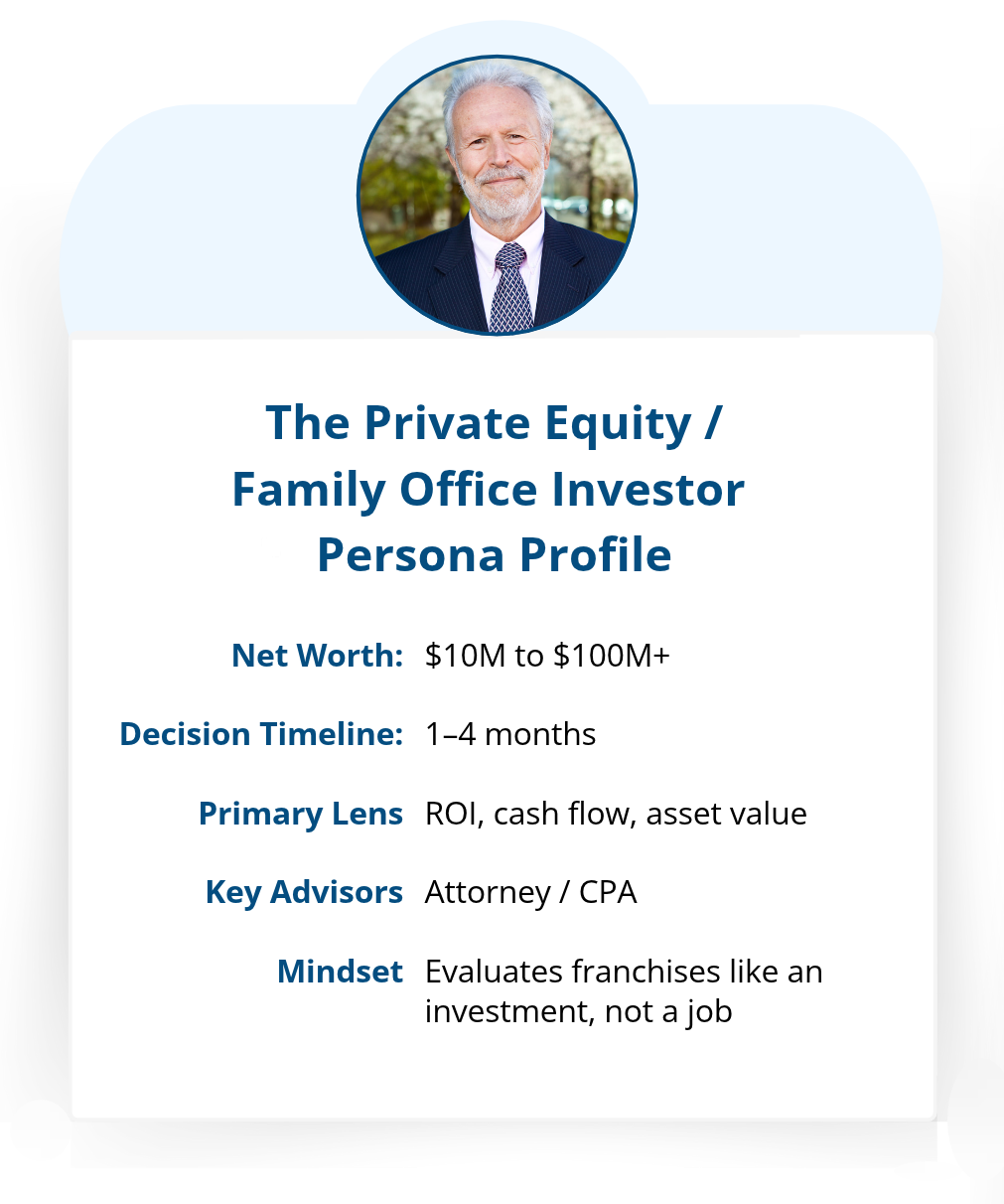
Two numbers define this persona inside the Franchise Ninja buyer persona framework. Estimated net worth ranges from $10 million to more than $100 million, the highest band of all 15 personas. The typical decision timeline for this persona is one to four months.
The private equity buyer is someone who wants unit economics, EBITDA margins, and exit multiples first. The storytelling can wait. This investor is not a niche player. FRANdata estimates that more than 12% of active U.S. franchise brands now have some level of private equity ownership or backing. Family offices are also becoming a more relevant source of capital for franchise operators.
What Is the Demographic Profile of the Private Equity / Family Office Buyer?
This persona is defined by capital structure rather than by age or career stage. The buyer is an investment organization, not an individual career changer. Understanding how each type is built helps you understand how each one thinks.
Two Types of Capital, Two Different Clocks
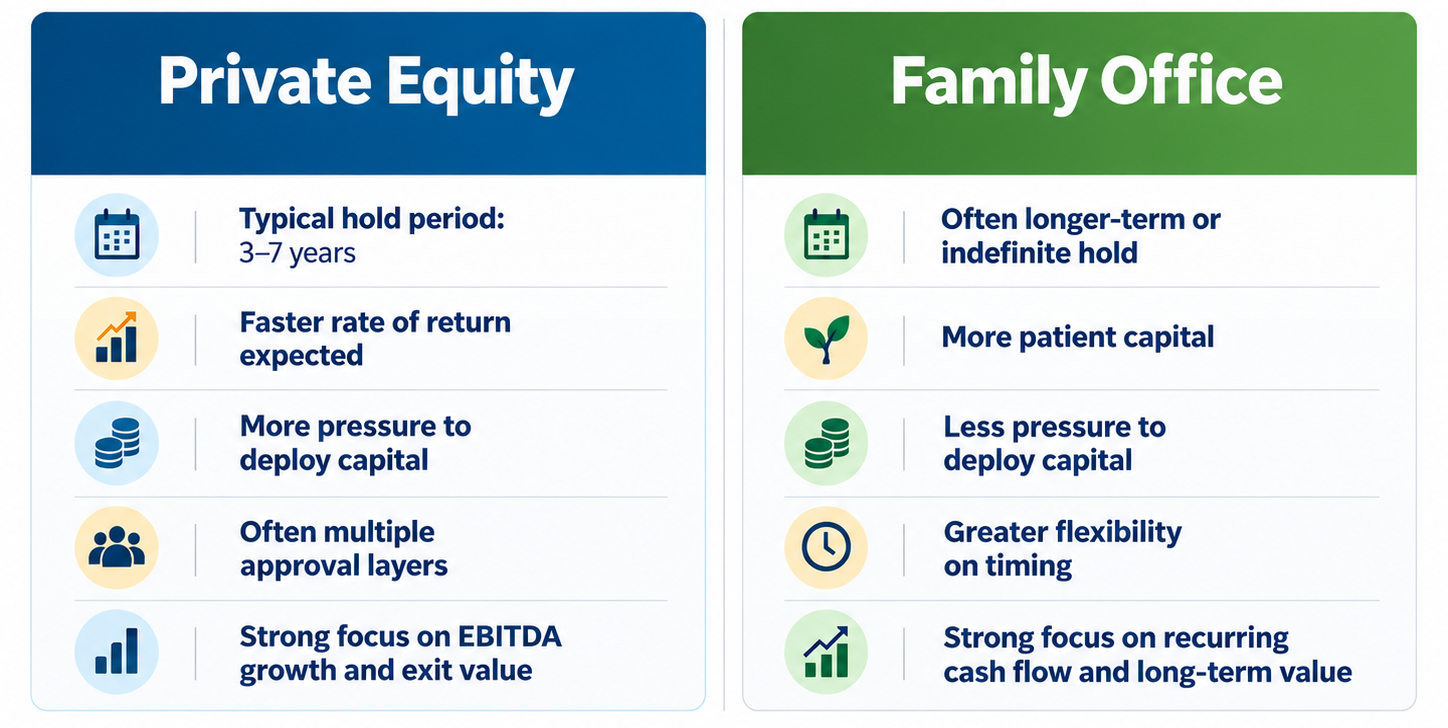
Private equity firms and family offices share a financial lens. They differ in how long they plan to hold an investment. That difference affects almost every decision they make.
The key contrasts between the two groups include:
Private equity firms typically hold businesses for three to seven years and expect a faster rate of return. The traditional private equity horizon at five to seven years.
Family offices tend to focus on intergenerational wealth with some looking to hold businesses forever.
Capital pressure also differs. Private equity firms often have fund investors pushing them to deploy capital. Family offices usually do not, so they can wait for the right deal.
The wider category is also broader than two labels. At the IFA 2026 Multi-Unit Franchising Conference, Susan Black-Beth of Auspicious Owl Group noted that "private equity" is often used too broadly. Outside capital can also include independent sponsors, strategics, search funds, and growth equity. Each has its own expectations, check sizes, and hold periods.
Where Family Office Wealth Comes From
Family offices were generally created by successful company founders. Some wanted to separate business wealth from personal wealth. Others needed to put proceeds from a liquidity event, such as the sale of a company, to work.
Direct investing is growing inside this group. About 46% of single family offices made direct private investments as of 2026, up from 28% in 2020, according to CT Acquisitions. The same source puts typical family office return targets at 10% to 15% IRR.
Financial Sophistication and Advisors
This buyer brings a high level of financial literacy. Our ROI-Driven Buyer profile notes that family offices and small institutional players share the same analytical lens as individual ROI investors, with capital that scales up significantly. They evaluate deals using a consistent set of measures. These typically include:
Payback period
Cash-on-cash return
Net present value (NPV)
Internal rate of return (IRR)
EBITDA margins and exit multiples
The decision-making unit looks different as well. For many first-time buyers, a spouse is the key influencer. For this persona, the influencer is typically a franchise attorney or CPA on retainer.
What Motivates the Private Equity / Family Office Buyer to Invest in a Franchise?
Capital productivity sits at the core of this persona's motivation. They want to know how reliably a franchise can turn invested dollars into predictable, scalable cash flow. Their drivers fall into four areas.
Return on Invested Capital. This investor compares a franchise to every other place they could put their money. Multi-Unit Franchisee Magazine reported that investors weigh a franchise business on its potential return on capital against other industries. Strong unit economics, high margins, and realistic payback horizons strengthen a brand's case.
Recurring Cash Flow. Predictable cash is the second pillar. Family offices are attracted by established brands, cash-generating locations, and the ability to expand through additional units.
Scalable Asset Value. Scale drives enterprise value for this buyer. Multi-unit portfolios sell at 4.5 to 6 times EBITDA, compared with 2.5 to 3.5 times for single units. That spread is exactly what this investor is buying. Panelists at the IFA Multi-Unit Franchising Conference pointed to strong operating models, repeatable systems, and real operating leverage as multi-unit businesses scale.
Operating Strength and Proven Leadership. Many of these investors are financial specialists, not operators. For this persona, when purchasing the strength of the existing management team is a consideration as some family offices are entering from outside the system and do not possess the operational expertise for daily operations.
That is why a proven franchise system is appealing. A tested playbook, established brand, training, and ongoing support reduce execution risk for an investor who will rely on managers to run the business.
What Kind of Franchises Draw Private Equity and Family Office Buyers?
This persona favors models that combine strong unit economics with room to grow. Scale is the common thread across every source we reviewed.
Size and Platform Thresholds
Scale thresholds help explain which opportunities get a meeting. Published benchmarks include:
Most private equity firms want a franchisee with $10 million or more in EBITDA, while family offices are increasingly active in the $2 million to $6 million EBITDA range.
Family offices generally want a "platform investment" of roughly 20 to 40 units with enough scale to support a management team.
Operators are generally looking for a business that has the ability to scale to 20, 40, 60, or 80 locations to attract private equity. Three or four units may not be enough.
For franchisors, the takeaway is clear. Multi-unit, territory, and area development pathways matter more to this persona than any single-unit pitch.
Categories With Investor Interest
Category interest spans food and non-food concepts. In an survey of franchise buyers, where family offices and private equity made up about 30% of respondents, the most-selected segments were:
Quick-service restaurants (84%)
Coffee and tea (24.5%)
Fast casual or casual dining (22.5%)
Health and wellness (20.4%)
Fitness (14.3%)
Our ROI-Driven Buyer research also points to staffing and recruitment, home services, senior care, and IT and business services. Family office interests can extend into hotels, gyms, automotive centers, and home-service businesses.
Upside Over Perfection
This buyer often prefers room to improve over a fully optimized asset. In one survey, 61% of respondents preferred an average business with operational upside at an average price. Fewer than 25% wanted top-tier assets at a premium multiple.
How Quickly Do Private Equity and Family Office Buyers Commit?
Our framework places this persona's decision timeline at one to four months. That speed reflects capital readiness and a disciplined review process. Outside research adds useful nuance.
Timing can vary by capital type. Family offices can take longer to decide because they are not under pressure to deploy capital. Deals involving private equity or family office money often require "multiple sets of approvals" and can take longer to close.
The evaluation itself is rigorous. Before committing, this buyer typically works through several steps:
Reviewing performance data, Item 19, and the FDD
Building or stress-testing financial models
Speaking with multiple existing franchisees
Comparing territory availability and development agreements across brands
Benchmarking the deal against other investments in their pipeline
This buyer can move quickly when the numbers hold. When they find missing data, unrealistic assumptions, or slow answers, they leave the process rather than wait.
What Pain Points Do Private Equity and Family Office Buyers Face?
This persona's concerns share one root fear. They worry about committing significant capital to a model that will not perform as presented.
Transparency and Data Quality
Limited or selectively presented Item 19 data creates immediate doubt. So do projections without clear assumptions. Newer brands face extra scrutiny because a short track record makes results harder to verify.
Financial Concerns That Stall Investment
Several financial risks can slow or stop a deal. The most common include:
Capital tied up in location-based assets that are hard to liquidate
Returns overstated by optimistic projections or heavy fee loads
Total investment that exceeds advertised ranges
Slow ramp-up that extends payback and lowers overall return
Remodel obligations that are unclear, which make underwriting difficult
Aggressive development requirements at a time when new-unit costs have risen
Operating and Key-Person Risk
Capital alone does not run a franchise, strong operational procedures must be in place. Investors also watch for key-person risk, meaning too much of the business depends on one individual.
Franchisor Relationship Risk
The franchisor relationship is part of the investment thesis. A strong operator in a strained brand relationship creates more risk, according to the IFA. In one survey, a franchisor's reputation for being reasonable or difficult ranked as the top franchisor consideration.
Process Friction
Slow follow-up and disorganized documents send a clear signal to this buyer. They read those gaps as signs of deeper organizational problems and disengage.
How to Market To and Attract the Private Equity / Family Office Buyer
This persona responds to marketing that treats them as investors, not leads. Every piece of content and every conversation should hold up to diligence.
Lead With Investor-Grade Content
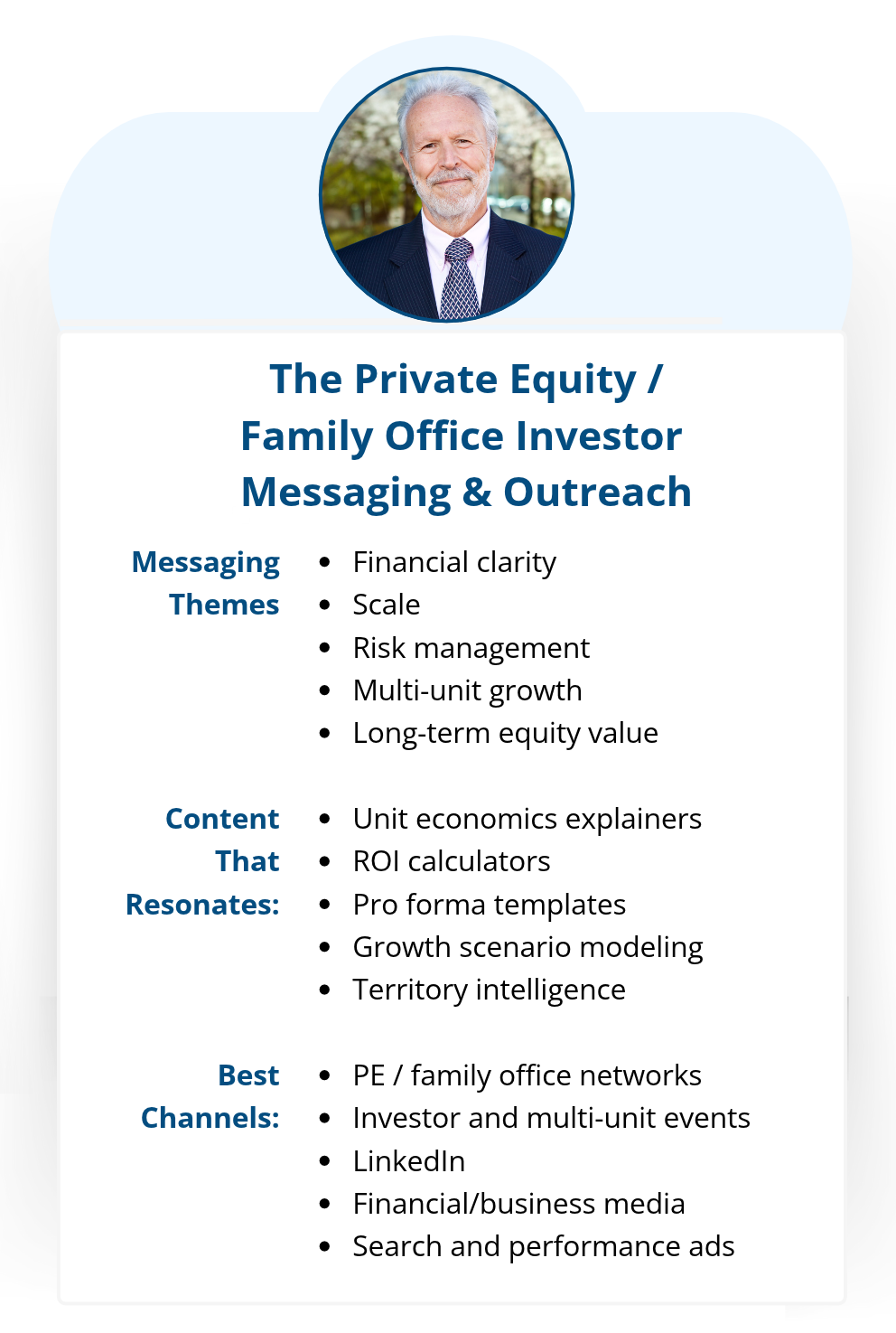
Data-forward content performs best. Our Buyer Insights framework highlights four nurture priorities for this segment: unit economics, territory intelligence, development agreements, and Item 19 clarity.
The strongest content formats help this buyer run their own analysis. Effective options include:
Item 19 and unit-economics explainers with appropriate disclaimers
ROI calculators and downloadable pro forma templates
Investment breakdowns covering breakeven points and payback analysis
Conservative, base, and upside growth scenarios
Webinars on top-performer benchmarks and the path to multi-unit scale
Messaging That Resonates
Messaging should lead with financial clarity, scale, and risk management. Themes that land include high margins, predictable cash flow, and a clear path to multi-unit growth. Portfolio language such as diversification and long-term equity value also connects.
Show your franchisor standards clearly. The Franchise Entrepreneur recommends that franchisors develop clear criteria for the institutional owners they will approve. Publishing your expectations on operations, development, and reinvestment signals a professional system.
Outreach and Channel Strategy
Reaching this buyer requires relationships as much as media. Most single family offices do not accept unsolicited deal flow and generally require a personal introduction. The most effective channels for this persona include:
Private equity and family office networks
Multi-unit franchise and investor events, such as the IFA Multi-Unit Franchising Conference
LinkedIn and financial or business media placements
FDD databases and franchise development conferences where these buyers already research
Search and performance ads built around franchise ROI and cash flow
Creative should be specific to this persona. One ad set cannot speak to a private equity investor and a lifestyle-driven first-time buyer at the same time. Build dedicated creative that leads with financial returns and test it within the persona group.
Solutions That Overcome Hesitation
The sales process should feel like a deal room, not a discovery day. Several practical steps help remove doubt and keep the deal moving. These include:
Early qualification on capital, hold period, portfolio strategy, and risk tolerance
A structured data pack with an FDD overview, sample P&L, KPIs, and territory maps
Validation calls with mid-pack franchisees as well as top performers
Clear answers on remodel schedules and development obligations
Fast, organized document access for the investor's attorney or CPA
One-to-one due diligence briefings with development leadership
When every stage delivers clarity and speed, you give this buyer what they need to commit.
What's Up Next?
The Private Equity / Family Office investor is the most capitalized and most exacting buyer in franchise development. Brands that meet this persona's standards for transparency, operational strength, and franchisor partnership are positioned to attract partners who can build across many markets. Brands that cannot meet those standards will be filtered out early.
Stay tuned for the next installment of our franchise buyer persona series. In the meantime, explore our other profiles, including the ROI-Driven Buyer, the Multi-Unit / Multi-Brand Mogul, the Master Franchisee, and the Corporate Refugee.
